Summary
I cut Rumo+ from 4 subjects to 2 so I could test whether the guidance works. The second version reached 48 skills across History, Math, Portuguese and Biology and piled up content and state inconsistencies. I cut it to 6 skills in Math and Portuguese, wrote the rules and acceptance criteria, and took the cycle into a working prototype in Google AI Studio.
Rumo+ is a study guide for Brazilian high school. The student answers five questions per skill, sees what the answers indicate, gets a suggestion of where to start and leaves with a short task to do now. When the evidence is weak, the app hands the choice back to them and says what the check doesn’t know.
The problem comes from the classroom. For about ten years as a K-12 teacher, I saw students with a textbook, a list of topics and a test date who still didn’t know what to review first. The closest alternative today is asking an AI, and for that the student has to be able to name their own difficulty.
This is an independent project of my own, with no commercial launch. Testing with people is planned and has not happened yet, so the case shows decisions, rules and the validation plan.
The problem
Having material in hand does not settle the choice. In my classroom experience, what was missing was clarity about what to review first.
The job to be done: when I have an assessment coming up and several topics to review, I want to find out where to start and understand why that choice makes sense, so I can use my time better and know what to do now.
I started with students in the 1st to 3rd year of Brazilian high school, in Math and Portuguese, at the moment they decide between one or two topics for a school test. The outcome I am after is the person understanding the guidance and starting a concrete task, without getting a definitive label about their ability.
How much evidence I had
No public data measures this moment of decision. National data shows why the scope matters:
- 8.6% of high school graduates had adequate learning in Math in Saeb 2023, Brazil’s national assessment, and 37.1% in Portuguese.¹
- Level 2 of 10 was the public school average in Math in the 3rd year of high school in Saeb 2025. Solving proportions (the rule of three) only appears from level 3 on. Proportion and graphs are two of the three Math topics in Rumo+.²
- 70% of high school students who use the internet already turn to generative AI for school research, and only 32% say they have received guidance on how to use it.³
These numbers size the learning gap. They do not prove that students struggle to prioritize, so I treated that struggle as a hypothesis. The signals I had about it came from three places:
- Classroom experience: recurring questions about what to review and differences between students’ self-perception and their answers. There was no systematic sampling.
- Research on self-regulation, metacognition and formative feedback: it makes the design plausible and produces no results about the app.
- Two exploratory conversations with experienced education professionals, who found the idea relevant. These were not structured interviews or a review of the prototype.
Why not ask ChatGPT?
This question comes before any other, because generative AI is already the student’s default alternative. It explains any topic and builds study plans with almost no adoption effort. Platforms like Descomplica, Estuda.com, Aprova Total, Khan Academy and Quizlet have a large volume of lessons and exercises, and the teacher knows the class and the test. I do not claim exclusivity in diagnostics or recommendations.
My bet is narrower. Facing a Math test, a student can ask “explain percentages to me” and get a whole lesson, when their difficulty was in reading the graph in the question. To ask an AI well, you have to know what you don’t know. Rumo+ looks at five answers first, then suggests where to start and shows why. The same evidence produces the same guidance.
This is the riskiest hypothesis in the case. It fails if, in a side-by-side comparison, ChatGPT leads to an equally concrete and understood first step, with the same effort or less. In that case, I revisit the proposal. Two possible paths would be supporting teachers in guiding review or helping students use AI better.
Hypotheses
I wrote eight hypotheses, each with what would weaken it. The ones that matter most for the next decisions:
- Priority. It fails if students already pick where to start with what they have, with no relevant friction.
- Explanation. It fails if they cannot explain the suggestion and its uncertainty in their own words.
- Micro-action. It fails if they cannot start the task with what is on the screen, or do not find it useful.
- Editorial quality. Weak questions make the conclusions fragile, even with correct logic.
The decision to cut scope
The cut came when expansion started creating more points of failure than learning about the core value.
V1, with History
In controlled scenarios, the Home, Map and Progress screens showed different states for the same performance. I defined a single source of records and versions for all screens.
V2, with four subjects
I expanded to History, Math, Portuguese and Biology, with 48 skills and AI-generated questions. Content and state inconsistencies followed, and large prompts consumed credits without reaching a stable result. I stopped the expansion.
V1.3, the redefined core
I cut back to 2 subjects and 6 skills, with five questions per skill, a versioned bank and small releases with acceptance criteria. First I need to prove the guidance, and learning support became an optional layer. I chose six skills because that is the scope I could review question by question, without claiming it is the ideal number.
The choices that mattered most, with the cost I accepted for each:
- One or two skills per session. I lose content coverage and deliver value after only a few questions.
- Five questions per skill. I lose measurement precision, so the interpretation is always provisional.
- Curated, versioned bank. Content production gets slower, and each piece of guidance can be explained and reproduced.
- Optional learning. The student spends less time in the app, and the cycle is still useful even if they stop there.
How it works
The main cycle ends in a concrete task:
- Goal: an upcoming test and one or two skills, chosen by familiar names and examples.
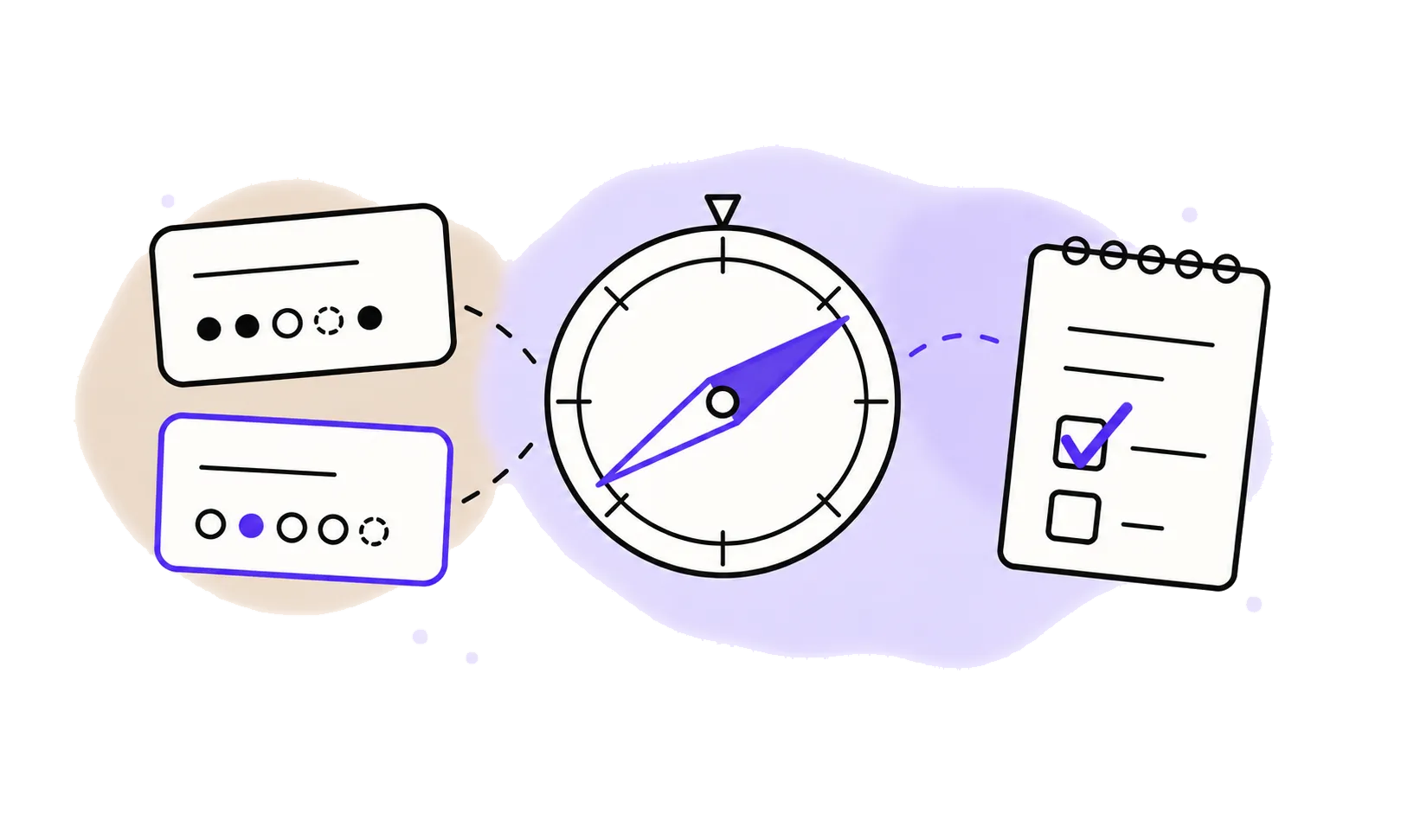
- Check: five questions per skill, with an “I don’t know” option.
- Evidence: correct answers, responses and the limits of the check, side by side.
- Decision: a provisional suggestion or a manual choice, depending on the difference between the skills.
- Micro-action: a short task with all the material to start now, even outside the app.
All guidance separates what was observed, what that allows us to conclude and what to do now. The screen says, for example: “In this check, there were 2 correct answers in 5 questions.” Then: “There are signs that justify attention; the check is brief.” It also makes clear which part was the student’s choice and which was the system’s suggestion.
Anyone who wants to go deeper enters the support layer, with an explanation and worked example, practice, a new check and reinforcement. Skipping this layer never blocks finishing the main cycle.
The priority rule
Five questions do not measure mastery. So the rule is conservative and, when the evidence is weak, hands the choice back to the student:
- One skill: shows a starting point and never talks about a “biggest difficulty”, since there is no comparison.
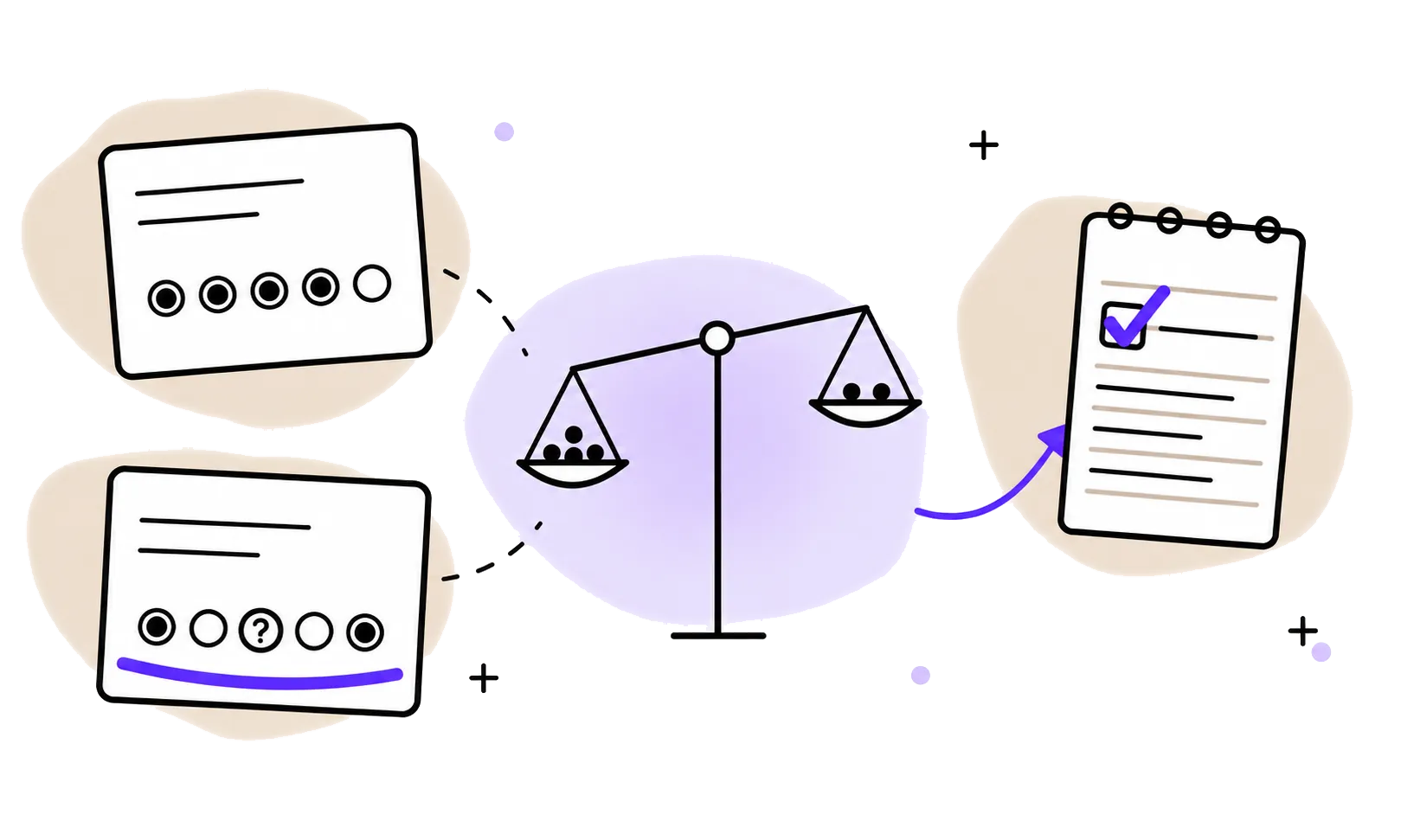
- Two skills, a difference of 0 or 1 correct answers: the student chooses, with no preselection and no automatic tiebreaker.
- A difference of 2 or more: provisionally suggests the skill with fewer correct answers.
- Weak questions or insufficient evidence: suggests no priority, even if the difference exceeds the limit, and explains why.
- 5 out of 5: acknowledges the result and offers optional consolidation, without making up a difficulty.
The two-answer difference is a product rule of mine, with no psychometric validation. “I don’t know” counts as an answer, in a state separate from a wrong one, and self-perception is kept apart without changing the priority.
I also specified what happens off the ideal path. A skill without five sound questions is unavailable and is never filled in with questions from another skill. A pause during the check reopens the pending question without duplicating answers. A micro-action that depends on a missing graph is blocked. Changing a question or an answer key does not reinterpret past attempts.
The central acceptance criterion: the cycle only delivers value when the task is complete and the student understands which evidence led to the guidance and which part was their choice. Reaching the results screen is not enough.
Content as part of the product
A bad question produces bad guidance, even with correct logic. An implausible distractor lets a student get it right by elimination, and asking someone to read a function without a real graph does not observe the skill of interpreting axes and scales.
The bank has 30 diagnostic questions and 30 micro-actions, across six skills:
- Math: percentages and proportionality, functions and graphs, probability.
- Portuguese: textual inference, argumentation, literary interpretation.
The AI-assisted review kept 15 questions, revised 14 and replaced 1, and the 30 micro-actions were reworked. I also wrote a release checklist per skill. The bank stays a draft (version 1.1.0-draft) until experts in each subject approve or block each set, and that review comes before any research with students.
What is built
The main prototype is in Google AI Studio, with the guidance cycle and the bank as a draft. The Learning Station is partial, in Math and Textual inference. Practice, a new check and reinforcement are specified, with no release on record as of October 2026.
An earlier version in Lovable was used to explore the design. Comprehension and learning still need testing with people, which has not happened yet.
I built it with AI-assisted prototyping tools, from the specifications, rules and acceptance criteria I wrote. My work was deciding what to build, in what order, and checking what each release proved.
How to validate
Research with minors requires authorization, assent and reviewed content, and today I do not have access to students. So I designed a cycle with people within my reach:
- Teachers: five to six interviews with Math and Portuguese teachers from my network. They show the problem from the outside and the teacher as a channel.
- Young people aged 18 to 21, recently out of high school: five to eight sessions. First the latest episode in which they did not know what to review, without showing the app, then the prototype with a simulated test.
- Side-by-side comparison: a Math test three days away, solved in ChatGPT, on a study platform and in Rumo+, in alternating order. I record the time to the first action, whether it is concrete and whether the person explains why they started there.
- Clarity test: the person reads the explanation in three scenarios and states, in their own words, the decision and what the check doesn’t know.
Adults remember high school and are no longer in it, so this cycle guides the design and does not replace research with students before any pilot.
The outcome that matters is the person understanding and acting:
- Comprehension: explains the decision and its limits, scored with a rubric in a moderated test.
- Action: starts the micro-action with the available material, with no outside help.
- Perceived usefulness: the guidance answered the question they started with.
The screen funnel only serves to find friction, because many completed checks can coexist with confusing guidance. The guardrails are rule integrity, absence of stigma, accessibility and a protected history. Success criteria will be defined before collection.
Risks and protection
- A label from five questions: provisional language, manual choice and abstaining when the questions do not support a priority. The product creates no “weak” or “strong” student profile, ranking or pass prediction.
- Minors: any pilot will require a legal and pedagogical review, including LGPD (Brazil’s data protection law) and ECA Digital (Law 15.211/2025). That review has not been done yet.
- Data: minimal collection, with no name, location or school when not needed. Data stays in the browser in this prototype, which removes the need for login and does not sync across devices.
- Business: the project has no business model or validated channel. Schools, teachers and direct access are hypotheses to investigate, with no commercial projection at this stage.
Next steps
- Content review: experts approve or block each set of questions.
- Cycle with adults: teachers and young people recently out of high school, with the prototype.
- AI comparison: the same test situation in ChatGPT, on a platform and in Rumo+.
- Decision: continue, adjust or revisit the proposal, with criteria defined before collection.
What I learned
- I cut from 48 to 6 skills, and that cut is what made the product testable. With 48, I could not review each question or tell whether the guidance worked.
- I treated the question bank as part of the product, with versions, a checklist and human review.
- I designed manual choice and abstaining so that five questions don’t turn into a label on the student.
- Automated checks show that the rules work as specified. Whether the guidance is understood and useful, only testing with people will tell.
- I would start with the ChatGPT comparison and the conversations with teachers before expanding to four subjects. V2 consumed time and credits that could have tested the riskiest hypothesis in the case sooner.
Sources
- Todos Pela Educação and Fundação Santillana. Anuário Brasileiro da Educação Básica 2025, with Saeb 2023 data.
- Inep/MEC. Saeb and Ideb 2025 results, released on 08/05/2026, as reported by Folhapress in Jornal de Brasília on 08/06/2026.
- Cetic.br/NIC.br. TIC Educação survey, 15th edition, released on 09/16/2025.