When everything works
A product looks good the whole time everything works. The payment is approved, the order arrives on time, the ride happens as usual, the password works and the flow ends as planned.
In that scenario, many products look alike. The flow was designed for that path, tested on that path, and that is where most screens make sense.
An important part of the experience, though, starts when something leaves that path. These are situations the person did not choose and that the product still has to solve together with them.
Three products facing the unexpected
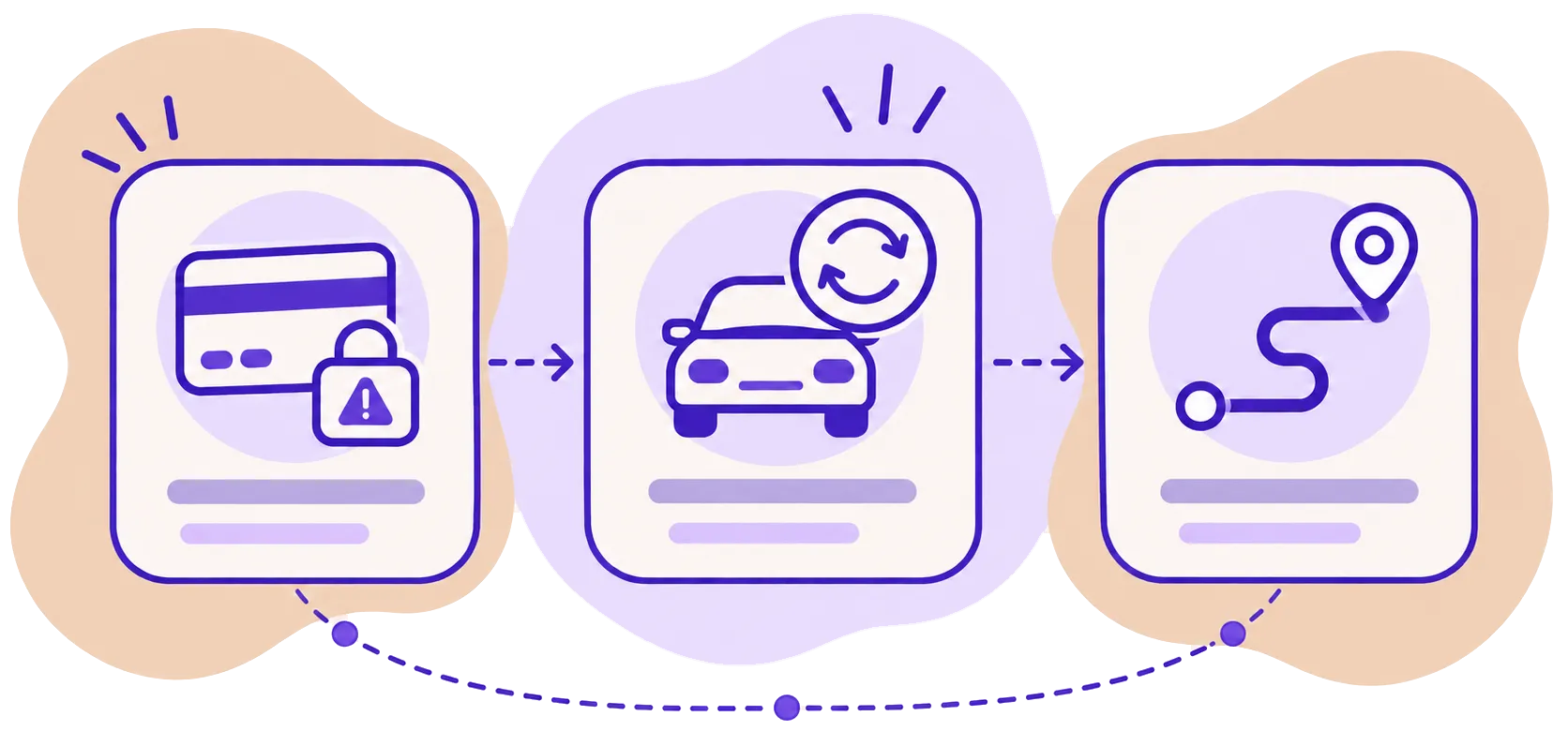
Nubank and the blocked purchase
When Nubank blocks a purchase that is out of the usual pattern, it explains why and shows the steps to confirm or dispute it. You leave knowing what to do.
The block itself is friction: the purchase did not go through, and the person may be at the checkout with a line behind them. What reduces the impact is what comes next. By giving the reason, the app answers the question of what happened to the card. By showing how to confirm or dispute, it turns the interruption into a task with a beginning and an end.
Uber and the canceled ride
When a driver cancels a ride on Uber, the app looks for another driver on its own, without waiting for the passenger to ask again.
The cancellation happens on the driver’s side, and the one who feels it is the passenger, still standing there waiting. By finding another driver automatically, the app takes on the job of fixing the failure. The passenger learns that something changed and does not have to request the ride again.
Google Maps and the missed exit
When you miss a turn or leave the route on Google Maps, the app recalculates the way automatically. You don’t have to start over.
Leaving the route happens all the time, and the product starts from that assumption. There is no error message and no confirmation request. The map shows the new path and the person keeps driving. It makes sense, because whoever is behind the wheel has no attention to spare for the app.
What the three have in common
In all three cases, the experience depends on how the product responds to the problem. There is a big difference between getting only a “something went wrong” and understanding why, knowing whether you need to try again, wait, dispute it or let the product sort it out on its own.
Nubank leaves the decision to the person. Uber and Google Maps solve it on their own: one looks for another driver, the other recalculates the route. In all three, the person knows what happens next.
The opposite is the generic message. When a payment fails and the screen only says “something went wrong”, the person can’t tell whether trying again will charge them twice. So they try again or contact support.
What the exception reveals
This also changes how I evaluate a product. It is in the exception that decisions that are usually hidden show up: how well the product anticipates the problem, guides the person on the other side and keeps a technical or operational failure from also becoming a bad experience.
To get to a good response, someone had to map what could go wrong, decide what the product solves on its own and what depends on the person, and write a message for each case.
When the user does not get there
Judging an experience only by how easily the user reaches the result leaves out the moment when they cannot get there.
That is why, when I analyze a flow, I also ask what happens at each step if something goes wrong: what the person sees, what they need to do and what the product can solve without asking them for anything.